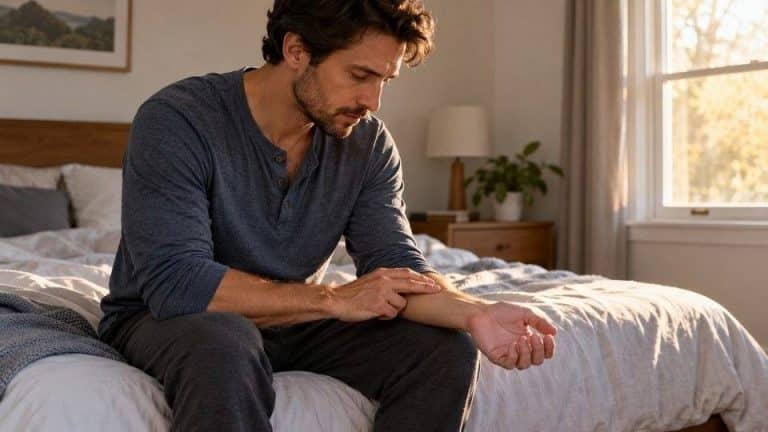

Holiday heart syndrome is an irregular heartbeat after a bout of heavy drinking. It often hits people with no known cardiac disease. The rhythm is usually atrial fibrillation (AFib), an irregular rhythm in the top chambers of the heart that can make the pulse fast or uneven. Doctors first described it in 1978, when patients came in with rhythm problems after weekends and holidays.
An irregular heartbeat after drinking needs a doctor, and chest pain means calling 911. Below are the symptoms, how long an episode lasts, and what lowers the odds of another one. If heavy weekends keep happening, the drinking is the part to treat. At Into Action Recovery, our alcohol rehab for men in Phoenix treats it.
What Is Holiday Heart Syndrome?

Holiday heart syndrome is a sudden, often temporary heart rhythm problem triggered by heavy alcohol consumption. AFib is the most common form, but other types of abnormal heart rhythm can show up too.
Where the Name Comes From
In 1978, Ettinger and his team reported on heavy drinkers in the hospital with AFib after weekend binges. Their cases clustered around holidays. A holiday party, special occasions, and long weekends are still when many men drink large amounts in a short time.
The trigger is the binge itself, so the same thing can happen after any heavy night of drinking. A fast pulse after drinking is not always holiday heart, though. Alcohol can also speed up a heart that keeps a steady beat, as the post on why your heart races after drinking explains.
Why Binge Drinking Triggers an Irregular Heartbeat
Researchers think several things happen at once during binge drinking. Alcohol appears to throw off the electrical signals that keep each heartbeat in step. It also turns on the body’s fight or flight system, which speeds up the heart rate. That system stays active during the hangover, too.
Alcohol also makes you urinate more. Over a heavy night, the body can lose electrolytes, the minerals that help carry the heart’s electrical signals. Together, these changes make it easier for the upper chambers to slip out of rhythm.
Holiday Heart Symptoms and When to Call 911
Heart palpitations are the most common symptom of holiday heart. They feel like a pounding, fluttering or skipping heartbeat. This kind of AFib tends to start 12 to 36 hours after the binge ends [1]. Other symptoms can include:
- A fast, uneven pulse
- Dizziness or feeling lightheaded
- Shortness of breath
- Tiredness or weakness
Some men feel nothing and only find out from a heart test. Still, an irregular heartbeat after drinking needs prompt medical care. Call 911 right away, and do not drive yourself, if it comes with any of these:
- Chest pain or pressure
- Fainting or nearly fainting
- Severe shortness of breath
- Stroke signs, such as a drooping face, a weak arm or slurred speech
Drinking strains the heart in other ways, too. The guide to how alcohol affects the heart covers them, from blood pressure to heart muscle.
How Long It Lasts and Whether It Comes Back

In more than 90% of cases, the AFib stops on its own within 12 to 24 hours after a person reaches care [1]. At the hospital, doctors use an ECG, a test that records the heart’s electrical activity. It identifies the rhythm and helps assess other urgent causes. An ECG alone cannot rule out every heart attack; symptoms and blood tests may also be needed. The table below sums up the usual course, based on the same review.
| Stage | What Usually Happens |
|---|---|
| When it starts | Often 12 to 36 hours after a binge ends |
| How long it lasts | Over 90% of episodes stop on their own within 12 to 24 hours of reaching care |
| Coming back | About 20% to 30% of people have another episode within 12 months |
Do not wait for a second episode to get assessed. Even a first episode needs prompt care, and these typical timings are not a reason to wait at home.
Even a Drink or Two Can Trigger an AFib Episode
Research has also tested smaller amounts of alcohol and the hours after a binge. One study followed people who already had AFib, and another followed young adults on a night of heavy drinking.
A Drink or Two in People Who Already Have AFib
Small amounts of alcohol can also set off AFib in people who already have it. A 2021 study in the Annals of Internal Medicine followed 100 adults with AFib for about four weeks. Each wore a heart monitor and an alcohol sensor, and 56 had at least one AFib episode.
After two or more standard drinks, the odds of developing AFib compared with no drinking were more than 3.5 times higher over the next four hours [2]. Even a single drink, such as 12 ounces of beer or 5 ounces of wine, about doubled the odds. That study looked at people who already had AFib, so it does not prove one drink causes holiday heart in everyone.
Binge Drinking in Young Adults
Binge drinking can trigger rhythm problems in young adults, too. A 2024 study from Munich tracked the incidence of rhythm problems in 193 young adults, a third of them women, around a planned binge with heavy alcohol intake. About 5% of them (10 people) had a notable rhythm problem, such as AFib, within 48 hours of binge drinking [3]. Most came during recovery, after the drinking ended.
Rhythm is not the only thing heavy drinking changes. Does alcohol raise blood pressure? Heavy drinking is linked to high blood pressure (hypertension), which is also a risk factor for AFib.
Atrial Fibrillation, Stroke and the Long Run
One episode of holiday heart usually passes. AFib itself still carries real risks, starting with stroke.
Stroke, Blood Clots and Other Risk Factors
When the upper chambers quiver instead of squeezing, blood can pool there, which can lead to blood clots. A clot that travels to the brain causes a stroke. AFib is tied to about a fivefold increased risk of ischemic stroke, the kind caused by a blocked blood vessel [4].
The CDC estimates that 12.1 million people in the US will have AFib by 2050. Its list of risk factors for AFib includes:
- High blood pressure
- Obesity
- Diabetes
- Heart failure and ischemic heart disease
- Moderate to heavy alcohol use
- Smoking
Moderate drinkers carry a higher risk too, since the CDC names moderate intake and not only heavy use. Drinking is a risk factor you can change.
What Happens When You Stop Drinking Alcohol
Stopping alcohol lowers the chance that AFib comes back. In a 2020 trial in the New England Journal of Medicine, 140 adults with AFib who drank on a regular basis were randomly assigned to quit or to keep drinking as usual. Over six months, AFib came back in 53% of the group asked to avoid alcohol, compared with 73% of those who kept drinking [5].
The group assigned to abstain actually reduced intake by 87.5% on average, so the result should not be presented as proof that everyone stopped completely. Heavy and binge drinking are also tied to worse heart outcomes, such as stroke, heart attack and other cardiovascular disease. Years of heavy drinking can weaken the heart muscle, too. That damage is called alcoholic cardiomyopathy.
If you drink heavily every day, talk to a doctor before you stop. Withdrawal can be dangerous, and it can cause a racing or irregular heartbeat of its own.
Frequently Asked Questions About Holiday Heart Syndrome
Is Holiday Heart Syndrome Dangerous?
A clinical review reports that most alcohol-triggered AFib episodes stop within 12 to 24 hours after presentation for care. It can still be dangerous. AFib raises the risk of blood clots and stroke, and a fast, uneven beat can cause chest pain or fainting. Any irregular heartbeat after drinking needs prompt care.
Is Holiday Heart the Same as AFib?
Holiday heart syndrome is the name for a rhythm problem triggered by heavy drinking. AFib is the rhythm it most often causes. Because AFib has many causes, such as high blood pressure and heart disease, a doctor checks for those as well as the drinking.
How Is Holiday Heart Syndrome Treated?
Treatment starts with assessment and an ECG to identify the rhythm, with blood tests or other checks when needed to evaluate emergencies. Many people need only monitoring, plus medicine to slow the heart if it is very fast. Doctors use a stroke risk score to decide whether blood thinners are needed. Stopping alcohol is the main step to prevent another episode.
Can I Drink Again After Holiday Heart?
A clinical review in StatPearls says no amount of alcohol is recommended as safe for preventing AFib. That includes moderate drinking. About 20% to 30% of people have another episode within a year, and in the 2020 trial, stopping alcohol cut repeat AFib. The evidence favors not drinking at all.
Getting Help for Drinking in Phoenix
If holiday heart keeps coming back, or you cannot stop after a heavy weekend, it may be alcohol use disorder. That is the medical name for what was once called alcoholism or alcohol abuse. Our alcohol rehab program for men in Phoenix treats the drinking behind these episodes.
For chest pain or stroke signs, call 911. In a crisis, call or text 988, or call the SAMHSA National Helpline at 1-800-662-4357.
This article is for informational purposes only and is not a substitute for professional medical advice, diagnosis, or treatment. If you have chest pain, fainting, severe shortness of breath or signs of a stroke, call 911 right away. If you drink heavily, talk with a doctor before you stop, because alcohol withdrawal can be dangerous.
Sources
- StatPearls. Holiday Heart Syndrome. StatPearls Publishing, NCBI Bookshelf. Updated January 16, 2024. https://www.ncbi.nlm.nih.gov/books/NBK537185/
- Marcus GM, et al. Acute Consumption of Alcohol and Discrete Atrial Fibrillation Events. Annals of Internal Medicine. Published August 30, 2021. https://www.acpjournals.org/doi/10.7326/M21-0228
- Brunner S, Krewitz C, Winter R, et al. Acute Alcohol Consumption and Arrhythmias in Young Adults: The MunichBREW II Study. European Heart Journal, 2024. Summary: American College of Cardiology Journal Scan, October 16, 2024. https://www.acc.org/latest-in-cardiology/journal-scans/2024/10/16/14/33/acute-alcohol-consumption
- Centers for Disease Control and Prevention. About Atrial Fibrillation. May 14, 2024 (last reviewed October 26, 2023). https://www.cdc.gov/heart-disease/about/atrial-fibrillation.html
- Voskoboinik A, Kalman JM, De Silva A, et al. Alcohol Abstinence in Drinkers with Atrial Fibrillation. New England Journal of Medicine. 2020;382:20-28. Published January 2, 2020. https://www.nejm.org/doi/full/10.1056/NEJMoa1817591