PTSD nightmares are vivid, frightening dreams tied to a trauma, and they are one of the core symptoms of post-traumatic stress disorder. They are common. In one community study, 71 percent of adults with PTSD reported nightmares, and in the National Vietnam Veterans Readjustment Study, 52 percent of combat veterans with PTSD reported significant nightmares [1]. Several therapies can reduce nightmares.
Some men try to drink the dreams away, and then the drinking and the trauma often do better treated together, the focus of PTSD and addiction treatment for men.
Why PTSD Causes Nightmares After Traumatic Events

PTSD can develop after traumatic events such as combat, assault, a serious crash, or seeing someone die.
Nightmares as a Re-Experiencing Symptom
Per the VA’s National Center for PTSD, the DSM-5 lists frequent nightmares as an intrusion symptom of PTSD, in the same cluster as flashbacks and unwanted memories. Insomnia appears in the criteria too, as a sign of hyperarousal. So a man with PTSD can struggle to fall asleep, then wake from a dream that feels like the event itself.
Some trauma nightmares replay what happened almost exactly. Others carry the same fear, anger, anxiety, or helplessness in a different story. The VA notes that veterans’ nightmares are more likely than civilians’ to be a replay. PTSD often travels with other conditions, and it is one of the co-occurring disorders seen alongside drinking and drug use.
What Happens During REM Sleep
Vivid dreaming is strongly associated with rapid eye movement, or REM, sleep, which occurs repeatedly through the night and tends to occupy longer periods later in the sleep period. PTSD is also associated with substantial sleep disturbance, but researchers do not have one simple REM-based explanation for why trauma nightmares occur.
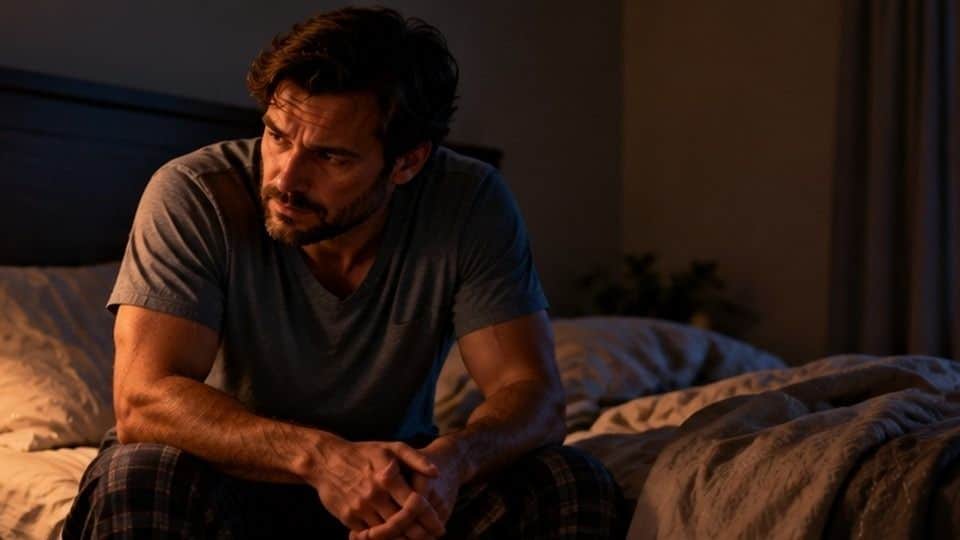
A man may wake from a PTSD nightmare frightened, sweating, with his heart pounding or with a strong sense that the event is happening again. Repeated shouting, kicking, or acting out dreams can have other causes as well and are worth mentioning during a sleep or mental health evaluation. The VA reports that posttraumatic nightmares are independently associated with daytime distress and impaired functioning [1].
What Makes PTSD Nightmares Worse
Nightmares tend to rise and fall with what is happening in a man’s life and what he puts into his body before bed.
Alcohol and Drugs
MedlinePlus lists drinking too much alcohol, abrupt alcohol withdrawal, street drug use, and stopping certain medicines such as sleeping pills or opioid pain medicines among possible triggers for nightmares [2]. Regular heavy drinking can also create a withdrawal risk if alcohol is stopped suddenly, so a man who may be physically dependent on alcohol should ask a health care professional about the safest way to stop rather than quitting abruptly on his own.
Other substances can disrupt sleep in different ways. Stimulants such as methamphetamine can produce prolonged wakefulness and serious psychiatric symptoms with heavy use; our chapter on psychosis tied to meth use covers that risk. Caffeine, nicotine, and prescription medications can also affect sleep, so clinicians need the full list when evaluating recurring nightmares.
Stress, Sleep Habits, and Medications
Fear of the dreams can become a vicious cycle. Some men put off bedtime to avoid them and wake more tired and on edge. Untreated sleep apnea, which the VA reports at higher rates with PTSD, can also contribute to broken sleep.
Stress at home or work, a new loss, or reminders of the trauma can lead to regular nightmares, and MedlinePlus also names eating just before bed and a new prescription as possible triggers. If nightmares begin after a change in medications, he should tell the prescriber rather than stop on his own. For prescription stimulants, see Does Adderall Cause Anxiety?
Why Drinking to Sleep Backfires
Alcohol can make a man drowsy, but falling asleep under the influence is not restful sleep. A 2025 meta-analysis of 27 studies in Sleep Medicine Reviews found that REM sleep was altered after as little as about two standard drinks, with larger effects at higher doses [3]. Falling asleep faster showed up only after about five drinks. The researchers also describe greater disruption in the second half of the night, as blood alcohol falls.
That second half is where REM sleep is concentrated, so it takes the most disruption. A man who drinks to manage trauma nightmares often trades them for broken sleep and early waking, and the dreams can come back hard when he stops suddenly. Swapping alcohol for sedatives or cannabis is not a fix either: the 2023 VA/DoD guideline for PTSD recommends against benzodiazepines and cannabis [4].
Treatments That Reduce Nightmares in PTSD
The two main guidelines weigh these options differently.
Imagery Rehearsal Therapy
Imagery rehearsal therapy (IRT), also called image rehearsal therapy, is a behavioral treatment. A man picks a recurring nightmare, writes a changed version of it, a new scenario lower in intensity or distress, and rehearses that version while awake. The American Academy of Sleep Medicine’s 2018 position paper names IRT as the one recommended treatment for PTSD-associated nightmares, and it lists progressive deep muscle relaxation among options for nightmare disorder generally [5]. The 2023 VA/DoD guideline found insufficient evidence to recommend for or against IRT.
CBT-I and Trauma-Focused Therapy
Cognitive behavioral therapy for insomnia (CBT-I) uses stimulus control, sleep restriction, changing unhelpful thoughts about sleep, and habits such as a steady wake time. The VA describes it as typically 6 sessions, ranging from 4 to 8, and reports that CBT-I is effective for both insomnia and nightmares in PTSD. Psychology and sleep medicine providers deliver it. Some men add progressive muscle relaxation or yoga before bed.
The 2023 VA/DoD guideline gives its strongest recommendation to three trauma-focused therapies: cognitive processing therapy (CPT), prolonged exposure (PE), and eye movement desensitization and reprocessing (EMDR). They work on the memories and feelings behind the dreams. The VA notes that nightmares often do not fully go away with trauma-focused treatment alone, so a sleep-focused therapy can be beneficial alongside it.
Prazosin for Nightmares
Prazosin is an alpha-1 blocker approved by the FDA for high blood pressure. In a large multi-site VA trial with PTSD patients, prazosin did no better than placebo, after earlier trials had looked promising. The AASM’s 2018 paper lists prazosin among treatments that “may be used.” The 2023 VA/DoD guideline suggests prazosin for PTSD nightmares, a weak recommendation, and does not recommend it for PTSD overall. Whether it is prescribed is a decision for a psychiatry provider.
PTSD in Men: Veterans, First Responders, and Civilian Trauma
PTSD in men often traces to combat, to years as a police officer, firefighter, or paramedic, or to civilian trauma such as assault, violent crime, or a serious crash. Some men never name it. NIMH notes that men are less likely than women to have received mental health treatment in the past year, and that mental health symptoms in men can show up as anger, irritability, misuse of alcohol or drugs, and high-risk activities [6].
So the first thing a family sees may be the drinking, not the dreams. Heavy drinking can also produce its own depression, a pattern called substance-induced mood disorder, and the severity of both problems can stay hidden for years. A man who has suffered through nightmares may describe it only as “not sleeping well.” They are a symptom. They say nothing about his character, his personality traits, or how tough he is.
What Partners Notice at Night and How to Help
A partner may notice restless sleep, sweating, abrupt awakenings, distress after dreams, or avoidance of bedtime before a man explains that he is having trauma-related nightmares. Repeated shouting, kicking, striking out or physically acting out dreams should also be mentioned to a clinician because those behaviors are not specific to PTSD and can occur with other sleep disorders.
If he wakes frightened or disoriented, keep the immediate environment safe, speak calmly, and give him time to recognize where he is. Avoid restraining or startling him if doing so could put either person at risk. Later, when he is fully awake, talk about what has been happening and encourage an evaluation if the nightmares are recurring or affecting daily life.
If he talks about suicide or has suicidal thoughts, call or text 988 for the 988 Suicide and Crisis Lifeline. Veterans, service members, and people concerned about them can dial 988 and press 1 for the Veterans Crisis Line. Call 911 for an immediate life-threatening emergency.
PTSD Nightmares Frequently Asked Questions
Can PTSD Nightmares Go Away?
Often, yes. With treatment, nightmares tend to become less frequent and less intense. Imagery rehearsal therapy targets the dreams directly, CBT-I improves sleep and nightmares, and trauma-focused therapy works on the underlying PTSD. Nightmares do not always clear with trauma therapy alone, so a sleep treatment is often added.
Is Nightmare Disorder the Same as PTSD?
No. Nightmare disorder is a sleep diagnosis for frequent, distressing nightmares that disrupt sleep or daily life, and it can occur without trauma. In PTSD, nightmares are one symptom among several, including flashbacks, avoidance, and hyperarousal. The American Academy of Sleep Medicine reviews treatments for both, and imagery rehearsal therapy is recommended for each.
When Should a Man See a Doctor About Nightmares?
MedlinePlus advises contacting a provider when nightmares happen more than once a week, keep interfering with sleep or daily activities for a long time, or begin after starting a new medicine. For a man with a trauma history who is also drinking to sleep, an evaluation that looks at both is worth getting sooner.
If nightmares, trauma, and drinking have become tangled together, Into Action Arizona offers residential treatment for men in Phoenix with structure, accountability, and a brotherhood of men doing the work.
This article is for informational purposes only and is not a substitute for professional medical advice, diagnosis, or treatment.
Sources
- Gehrman P. Sleep Problems in Veterans with PTSD. VA National Center for PTSD (for providers). Last updated April 15, 2026. https://www.ptsd.va.gov/professional/treat/cooccurring/sleep_problems_vets.asp
- MedlinePlus, U.S. National Library of Medicine. Nightmares. Reviewed May 15, 2026. https://medlineplus.gov/ency/article/003209.htm
- Gardiner C, Weakley J, Burke LM, et al. The effect of alcohol on subsequent sleep in healthy adults: A systematic review and meta-analysis. Sleep Medicine Reviews. 2025;80 (April 2025). https://www.sciencedirect.com/science/article/pii/S1087079224001345
- U.S. Department of Veterans Affairs and U.S. Department of Defense. The Management of Posttraumatic Stress Disorder and Acute Stress Disorder: Synopsis of the 2023 U.S. Department of Veterans Affairs and U.S. Department of Defense Clinical Practice Guideline. Annals of Internal Medicine. 2024;177(3):363-374. Published February 27, 2024. https://www.acpjournals.org/doi/10.7326/M23-2757
- American Academy of Sleep Medicine (Morgenthaler TI, et al.). Position Paper for the Treatment of Nightmare Disorder in Adults: An American Academy of Sleep Medicine Position Paper. Journal of Clinical Sleep Medicine. 2018;14(6):1041-1055. Published June 15, 2018. https://pubmed.ncbi.nlm.nih.gov/29852917/
- National Institute of Mental Health. Men and Mental Health. Last reviewed May 2024. https://www.nimh.nih.gov/health/topics/men-and-mental-health